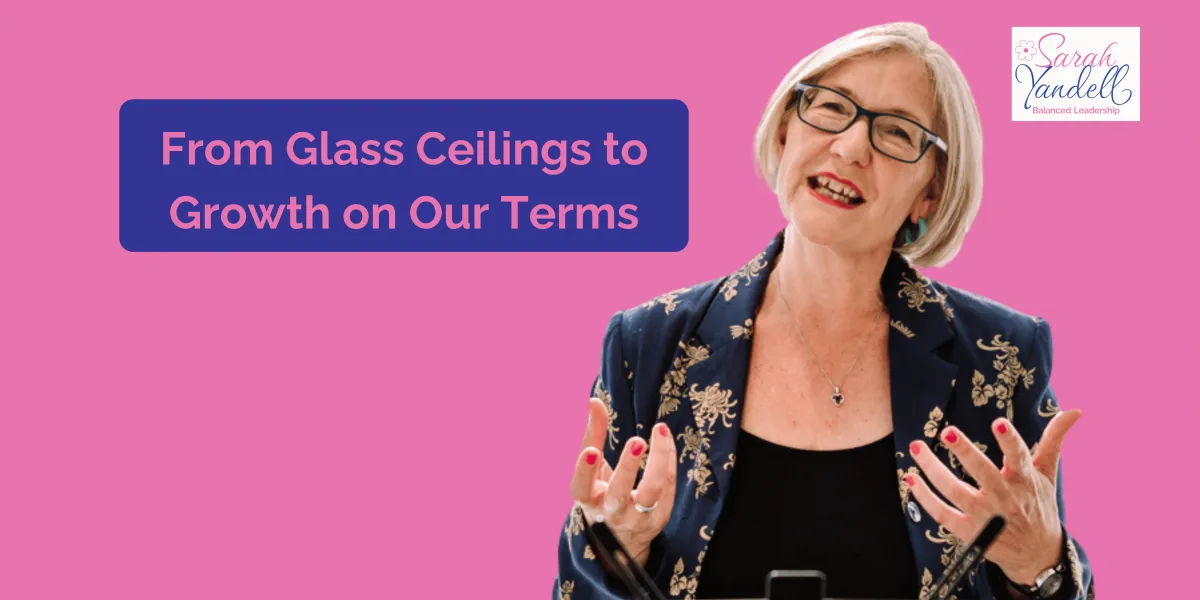
From Glass Ceilings to Growth on our Terms
When I was born in the 1960s, women in many countries needed their husband’s permission to open a bank account. Today, I work with ambitious women founders building multi-million-pound businesses; designing companies that create profit, freedom and impact. The distance between those two realities is not just cultural; It’s deeply personal.
Here’s what I’ve seen change over six decades; and what it means if you’re building a business today.
The 1960s: Leadership Wasn’t Expected of Us
When I was born, the script for women was largely pre-written. Finish school. Get married. Have children. Professional careers were possible but leadership was rare. But my parents quietly disrupted that narrative.
My father was a teacher and highly involved in our upbringing. My mother trained in Montessori education and went on to run her own nursery school. I grew up seeing a woman build and run her own business long before I understood what entrepreneurship really meant.
The seed was planted early. Women could create something of their own.
The 1970s: Equal Pay and Breaking Barriers
The 1970s brought equal pay legislation and visible change. When Margaret Thatcher became Prime Minister, it signalled that women could reach the very top. But at this time, Leadership still meant conforming to male norms. To succeed, women often had to adapt to existing systems rather than redesign them.
The message was clear: If you want influence, fit in. Many ambitious women internalised that rule, including me.
The 1980s: “Too Emotional” to Lead
By the 1980s, more women were entering senior roles. But corporate culture rewarded long hours, toughness and emotional detachment.
My early career was in the hotel industry. I was promoted quickly into management but I was repeatedly told I was “too soft” and “too emotional.” At the time, I tried to toughen up.
Now I understand something different. What they called emotional was actually emotional intelligence; something now recognised as one of the most powerful leadership tools a founder can have.
Back then, it was undervalued. Today, it’s a competitive advantage.
The 1990s: The Glass Ceiling and the Rise of Female Founders
In the 1990s, the phrase “glass ceiling” became common. Women were present in management, but stalled before the boardroom. Many chose to leave corporate paths and build businesses on their own terms.
In the mid-90s, I was given the opportunity to build a business unit within an international student travel company. There was only one woman on the senior team. But I had a boss who saw something in me I hadn’t seen in myself; pure : determination.
I built that business from scratch to $10 million in revenue with a team of 10. I travelled the world contracting hotels, building booking systems (before online platforms existed), and distributing globally. It taught me something every founder eventually learns:
When you build it yourself, you understand it at a different level.
But I also realised that as a middle manager, my growth was capped. So I left to complete an MBA full-time investing in myself which was a massive leap of faith as well as money.
The 2000s: Scale, Success and Financial Reality
The early 2000s saw more women stepping into entrepreneurship. Networks grew. Mentorship expanded but burnout was common. Women were still primary carers while also building businesses.
During my MBA, over 80% of my cohort were men, many training for consultancy careers. The curriculum focused heavily on finance and economics. I felt completely out of my depth.
It also forced me to confront a truth that every ambitious founder must face: you cannot scale when you do not understand finance. Soon after, I co-founded a specialist rail tour operator. I wrote the business plan. I saw the opportunity.
We exceeded forecasts immediately - £500k turnover in year one and grew to £10 million turnover with a team of 25. There were lots of ups and downs including a financial crisis and the increasing pressure on cash flow.
On top of this I had unexpectedly become pregnant after many rounds of IVF treatment and continued to commute into London while breastfeeding. I had to step back operationally and was not as close to the business.
The 2010s: Redefining Leadership
It was in the 2010s that leadership began to shift meaningfully.
Inclusive leadership. Values-driven culture. Emotional intelligence. Autonomy.
We stopped trying to lead like men. We started leading like ourselves.
By this stage, my business had matured. With a strong leadership team in place, I could step out of day-to-day operations. I could do the school run. I could design my time differently.
This was a breakthrough realisation: scale is not just revenue growth, it’s operational independence. For ambitious women founders, that distinction matters enormously.
However cash flow was an increasing strain on the business and we were eventually forced to sell to a larger US company. The team and brand survived. The stress nearly broke me. It was the hardest lesson of my career: Founders must maintain visibility over cash, even when they step back.
The 2020s: Reinvention and Intentional Growth
The pandemic accelerated change more than decades of policy reform.
Flexible working became mainstream. Technology enabled autonomy. Many women reassessed what success meant. At the same time, female representation at CEO level in major corporations remains under 10%. We have momentum but not parity.
For me, the 2020s required reinvention. Travel collapsed during Covid. My entire industry was shaken. But reinvention is a founder skill.
Through outsourcing work and building my coaching practice, I’ve seen dozens of businesses from the inside.. Different sectors. Different models. Different ambitions. And I’ve noticed a pattern:
The most successful women founders are not trying to prove themselves anymore. They are building businesses aligned with:
🙋♀️Their values
🙋♀️Their desired lifestyle
🙋♀️Their financial goals
🙋♀️Their appetite for growth
Not someone else’s version of success.
What This Means for Ambitious Women Founders Today
We no longer have to fit into leadership moulds that weren’t designed for us.
But we do need:
☑️ Financial clarity
☑️ Strong systems
☑️ A motivated leadership team
☑️ A long-term strategic vision
☑️ The confidence to define success on our own terms
Because ambition without structure leads to exhaustion and structure without ambition leads to stagnation. The opportunity for women in leadership has never been greater. But the real shift is this:
We are no longer asking for permission.
We are building anyway.
My Mission Now
After over 30 years of building, scaling, stepping back, selling and reinventing, I know this:
☑️ You do not need to become harder to lead well.
☑️ Emotional intelligence is not weakness - it is leverage.
☑️Financial visibility protects your freedom.
☑️The right team gives you back your life.
☑️Reinvention is a strategic skill.
I now work with ambitious women founders who want more than revenue.
🙋♀️They want clarity.
🙋♀️They want influence.
🙋♀️They want a business that supports their life; not consumes it.
Because leadership, at its best, expands your world. And we have earned the right to build it that way.
Register to receive my weekly email; The Resilient Founder where I'll be sharing honest reflections, lessons learned, and practical strategies from my own journey: co-founding and scaling an £8 million business… while navigating motherhood, financial challenges and self-doubt.
And if you are ready to take the next step, you will find my FREE Webinar will help you.
