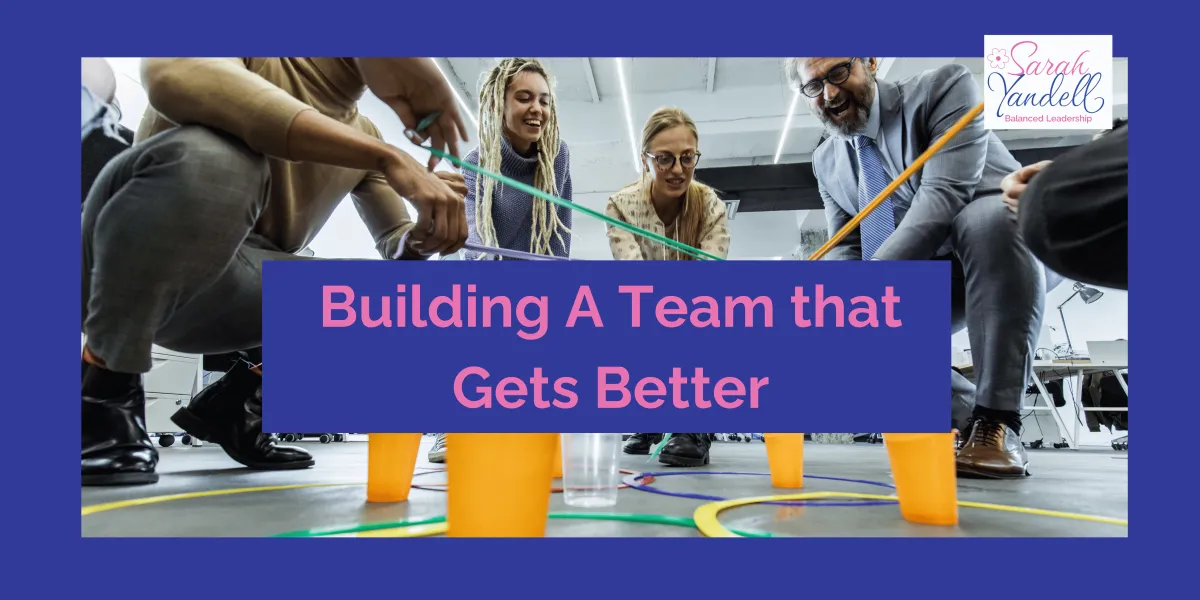
Building a Team that Gets Better
Scaling Up is not about Recruiting Better People
It’s about building a team that keeps getting better
When most business owners talk about scaling, they default to one thing: “I just need better people.”
I get it. I used to think the same.
But here’s what I’ve learned from growing businesses to £8m with relatively small teams:
Growth doesn’t come from recruiting smarter people. - it comes from building a team that have the motivation and innate skills that mean they take initiative and learn faster.. A team with a mixture of skills that complement each other.
That’s the real shift.
These are teams that don’t just perform… they continuously improve. And in my experience, that’s exactly what separates businesses that scale from those that stall.
Let’s break down what that looks like in practice.
1. Stop Chasing Performance - Build a Culture of Improvement
Most teams are focused on hitting targets.
Excellent teams are focused on getting better every week.
The highest-performing teams aren’t the most talented; they’re the ones that learn the fastest.
This is what happened in my first business. Early on, we didn’t have the “perfect” recruits.. But what we learnt was that we needed people with the right attitude rather than previous experience. And more importantly we needed team players who consistently wanted to improve.
We weren’t just asking: “Did we hit the numbers?” we were also asking: “What did we learn this week that makes next week easier?”
That mindset compounds.
2. Make Experimentation the Default (Even When Things Are Working)
One of the biggest traps in scaling is this: You find something that works… and then you stop evolving. Average teams stabilise. Brilliant teams keep experimenting, even when things are going well.
In one of my businesses, we had a marketing channel that was performing brilliantly - paid advertising on Google.. It would have been easy to focus on this one marketing channel; instead we kept testing:
☑️New messaging
☑️Different offers
☑️Alternative channels
Some worked. Some didn’t.
But over time, those small experiments created a pipeline of growth; so we were never reliant on one thing and that’s how you de-risk scaling.
3. Create Psychological Safety but Don’t Lower Standards
For small businesses this can be very challenging as teams are small and change is constant; but people must feel able to speak up, challenge ideas, and admit when something isn’t working.
But safety without accountability? That’s just comfort. So it is important to balance both so people feel supported and are also expected to deliver. :In practical terms, that means:
☑️Normalising “What are you stuck on?” conversations
☑️Encouraging challenge, not just agreement
☑️Holding people accountable for improving, not just performing
This balance is where real growth happens.
4. Shift from “Reporting” to “Problem Solving”
Most meetings are updates. With high performing teams, meetings are problem-solving sessions. This can be a challenge when everyone is busy and needing to get back to the “doing” but rethinking your team meetings can be transformational.
What I have found is:
❌ Reporting maintains the status quo
☑️ Problem-solving drives growth
If your team meetings feel repetitive, this is usually why.
5. Leaders: Get Back in the Trenches (at the Right Moments)
As you scale, there’s a temptation to step back completely. But the best leaders don’t disappear; they lean in at critical moments. Great leaders “roll up their sleeves,” even when they don’t have to.
I’ve done this many times: From picking up the phone when it was ringing off the hook to helping out the cleaner when she needed to get back to an ill child. This is not about micromanaging, it’s about understanding what questions clients are asking, what challenges your team are facing and showing that you are visible. It helps remove friction and accelerates learning for the team.
6. Make Feedback Feel Like Support (Not Criticism)
If feedback feels like judgment, people avoid it. If it feels like support, people seek it. Good leaders build cultures where feedback is:
☑️Frequent
☑️Constructive
☑️Expected
In my experience, this is one of the biggest things to unlock growth. When your team starts saying: “Can you give me feedback on this?” you know you’ve got something right.
7. Lead with Meaning, not Just Metrics
Metrics matter. Of course they do. But if your team is only focused on numbers, you’ll hit a ceiling. The best teams are connected to:
☑️Why their work matters
☑️Who they’re helping
☑️What they’re building together
Because meaning fuels motivation in a way metrics alone never will.
Bringing It Back to Scaling
If you’re stuck in the day-to-day of your business, this is often why:
☑️You’ve built a team that delivers…
❌ But not a team that improves.
And without continuous improvement, scaling stalls.
Because scaling isn’t about adding more people.
It’s about building a team that:
☑️ Solves problems without you
☑️ Improves without being told
☑️ Grows faster than the business demands
You don’t need a bigger team.
You need a better system for how your team works together.
Because when you get that right…
👉 Growth becomes sustainable
👉 Pressure reduces
👉 And you finally start stepping out of the day-to-day
About the Author
Sarah is a business founder, MBA graduate and coach who has built and scaled businesses to over £8 million in revenue with teams of up to 25.. She now helps ambitious founders gain clarity, build motivated teams and create businesses that support the life they want to lead.
Register to receive her weekly email; The Resilient Founder where she'll be sharing honest reflections, lessons learned, and practical strategies from her own journey: co-founding and scaling an £8 million business… while navigating motherhood, financial challenges and self-doubt.
And if you are ready to take the next step, you will find her FREE Webinar will help you
☑️Recruit the right people first time so they fit with your core business values.
☑️Motivate your team and communicate effectively so they consistently deliver beyond expectations
☑️Step back from the day job and replace yourself with your team.
