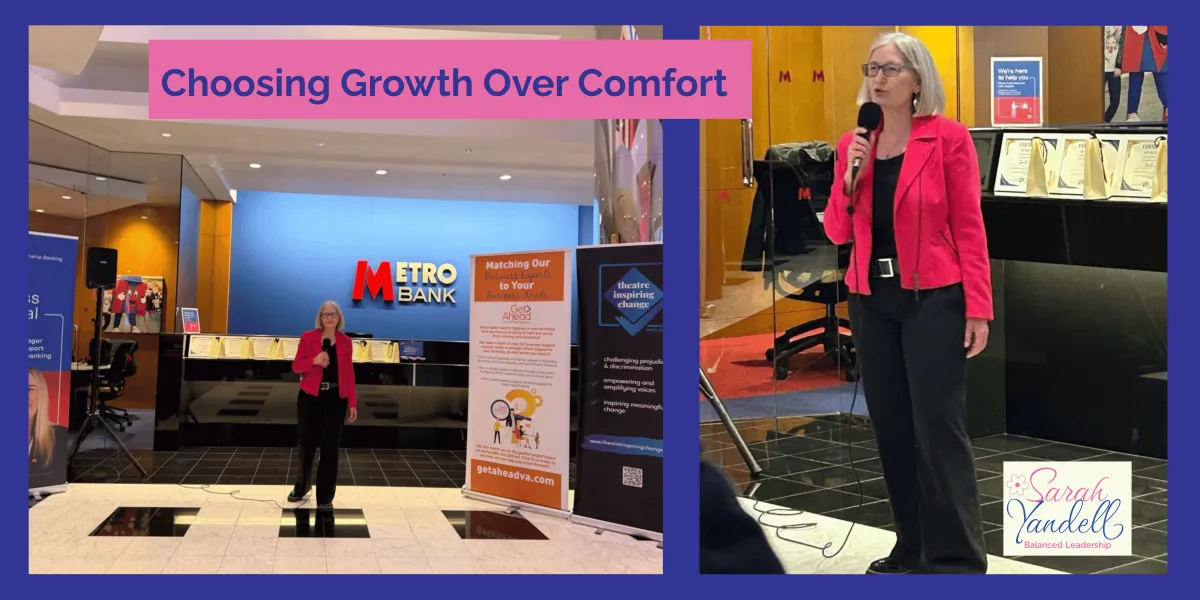
Choosing Growth over Comfort
Running a business can feel exhilarating one moment and overwhelming the next.
Many business owners experience this as their companies begin to grow and become more complex. The early days of a business often feel simpler with fewer people, fewer decisions, and a clear sense of control. But as success builds, so does responsibility.
🔷More clients bring more complexity.
🔷More team members mean more decisions.
🔷And the founder often becomes the person everyone turns to for answers.
Without the right clarity and structure, even highly capable leaders can start to feel overwhelmed.
Having built businesses to £8–10 million in revenue, I’ve seen first-hand how quickly growth can create complexity if the right foundations aren’t in place. But the most powerful mindset shift I learned came from one pivotal moment in my own career.
Everything in my career looked successful on the surface. I had built a business unit from scratch and grown it to £10 million in revenue. I was leading a talented team, the business was performing well, and I reported directly to the board. By most measures, I had reached a level many people aspire to.
But something didn’t quite sit right. I wanted to keep learning. I wanted to keep growing. My team no longer needed me and I wanted a new challenge. So I went directly to the CEO and asked a simple question:
“What would the next step look like for me?”
The answer was honest and clear.
There wasn’t one.
I was already reporting to the board, and there wasn’t another step up available in the organisation.
For some people, that might have been the moment to settle in and enjoy the success they had already achieved.
But for me, it triggered a different question:
If growth isn’t possible here, where do I need to go next to keep developing? And that question led me to make one of the biggest decisions of my career.
I left a successful role and chose to complete an MBA full time, which I self-funded.
From the outside, it probably looked risky; walking away from a brilliant position to go back to study. But looking back now, it was one of the most important mindset decisions I ever made.
Because it reinforced something I still believe today: Growth rarely happens inside your comfort zone.
As businesses grow, many founders discover that the skills that helped them start the business are not always the same skills needed to scale it.
☑️More opportunities appear but...
BUT
❌More people rely on you.
❌And suddenly the founder becomes the centre of every decision.
Common signs of this stage include:
👉Constantly switching between priorities
👉Feeling responsible for every decision
👉Struggling to step back from day-to-day operations
👉Working harder but feeling less in control
The challenge isn’t usually capability.
It’s a lack of clarity and structure as the business becomes more complex.
And this is where mindset becomes incredibly important. When leaders feel overwhelmed, it’s rarely because they lack ability; it’s usually because the business has outgrown the systems and structure that once worked.
Why Structure and Clarity improve Leadership Mindset
One of the biggest lessons I’ve learned through building and growing businesses is this: mindset isn’t just about resilience or positive thinking. It’s about creating the conditions where clear thinking becomes possible.
When everything feels urgent and chaotic, even experienced leaders struggle to focus. But when there is structure, priorities become clearer, decisions become easier and leaders regain a sense of control.
That sense of control is one of the most powerful ways to reduce overwhelm. Instead of reacting to every new challenge, you can lead with intention.
Why letting go of Perfectionism helps Business Owners Scale
Another hidden cause of overwhelm is perfectionism. Many business owners carry invisible standards in their heads. They expect excellence but rarely define what “good enough” actually looks like.
The result is constant pressure; for themselves and for their teams.
One mindset shift I often encourage founders to make is asking to ask themselves:
☑️ What does 80% done look like?
☑️ What outcome actually matters most here?
☑️ Where could we simplify?
Lowering unnecessary pressure doesn’t mean lowering ambition. It simply means focusing energy where it truly counts.
How Leaders can create a Culture where Teams speak up
Strong businesses are built on open communication. People need to feel safe admitting when they are at capacity rather than silently pushing through until performance drops.
As leaders, we shape that culture.
Instead of asking, “can you take this on?” we might ask: “what would make this manageable?”
That small shift opens the door to better conversations, stronger collaboration, and more sustainable performance.
What Resilience really means for Business Owners
Throughout my journey from building businesses to £8–10 million, navigating the 2008 recession, and overcoming setbacks like being let down by a business partner; I’ve learned that resilience isn’t about endless endurance. True resilience is about adapting. It’s about learning from setbacks. And sometimes, it’s about stepping back in order to move forward more effectively.
The decision to leave a successful role and invest in my own development through an MBA was one of those moments.
At the time, it felt like a leap.
But it gave me the perspective, confidence, and strategic thinking that shaped everything that came afterwards.
The Leadership Mindset that supports long-term Business Growth
Running a business will always involve challenges. There will be uncertainty, difficult decisions, and moments when everything feels more complex than expected.
But the leaders who sustain long-term growth tend to focus on three things:
☑️ They create clarity rather than reacting to chaos.
☑️ They build structure instead of carrying everything themselves.
☑️ And they continue investing in their own development as their business grows.
Because ultimately, the growth of a business will never outpace the growth of the business owner leading it.
A simple Business Framework to reduce overwhelm
Over time I realised that many founders don’t need more ideas; they need a simple structure that helps them focus on what matters most.
That’s why I developed the BUILD framework, which focuses on five key areas every growing business needs to master.
B – Blueprint
Create a clear vision and strategic direction so everyone understands where the business is heading.
U – Uncover
Know your numbers. When business owners truly understand their financial performance, uncertainty reduces and better decisions follow.
I – Implement
Put the right systems and processes in place so the business runs consistently without relying on the founder for everything.
L – Leverage
Build and empower a team that shares the load and brings their strengths to the business.
Create a future-focused business that continues to grow without burning out the founder.
When these five areas begin to align, something powerful happens.
☑️The noise reduces.
☑️Decisions become clearer.
☑️And the founder starts to feel back in control again.
About the Author
Sarah is a business founder, MBA graduate and coach who has built and scaled businesses to over £8 million in revenue with teams of up to 25.. She now helps ambitious founders gain clarity, build motivated teams and create businesses that support the life they want to lead.
Register to receive her weekly email; The Resilient Founder where she'll be sharing honest reflections, lessons learned, and practical strategies from her own journey: co-founding and scaling an £8 million business… while navigating motherhood, financial challenges and self-doubt.
And if you are ready to take the next step, you will find her FREE Webinar will help you
☑️Recruit the right people first time so they fit with your core business values.
☑️Motivate your team and communicate effectively so they consistently deliver beyond expectations
☑️Step back from the day job and replace yourself with your team.
