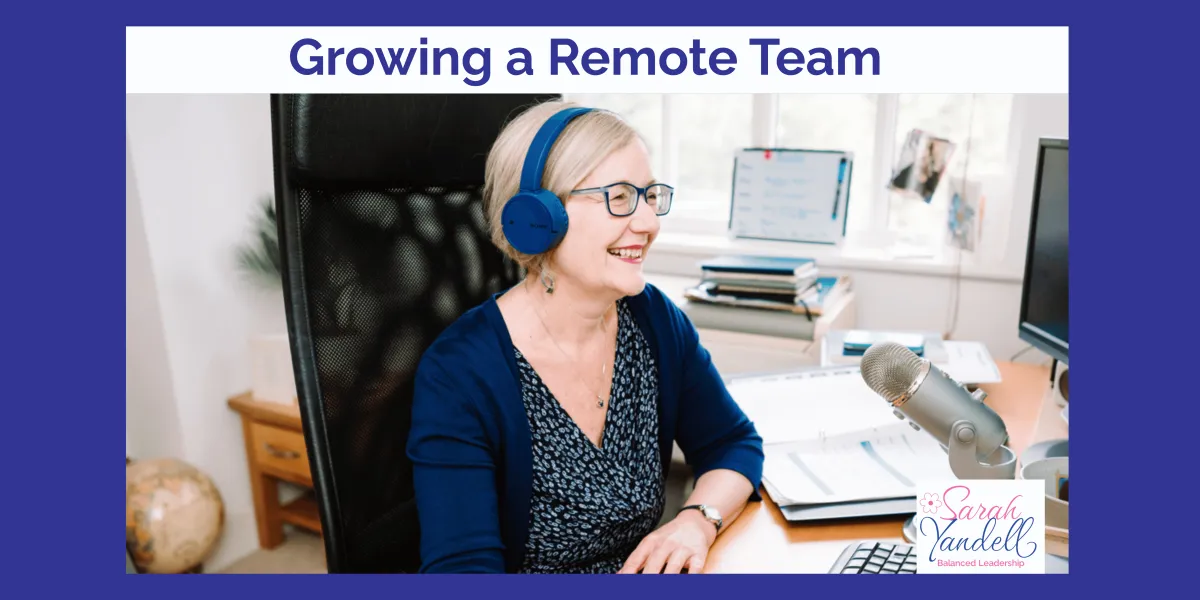
Scale by Growing a Remote Team
How Founders Can Grow Flexible, Remote and Distributed Teams who are Aligned to Your Vision
Scaling a business is exciting. More clients, more opportunities, more revenue and more people in the business to help you make the vision a reality.
However, there is a point where growth can create a problem of its own. The team gets bigger, people become more dispersed, more decisions need to be made, and suddenly as the founder you can find yourself spending more and more time managing people, answering questions and trying to keep everyone moving in the same direction. Growth can very quickly become overwhelming.
This is something I personally experienced when scaling my first business and I can relate to a recent Harvard Business Review article, How to Manage a Sprawling Team without Burning Out, which highlights exactly this challenge: when teams expand rapidly but the systems and support around them don't evolve at the same pace. My mistake and the mistake I have seen many times in growing businesses is to think that scaling is just about adding more people. It is far from that simple.
The Opportunity (and Challenges) of a more Flexible Workforce
There has never been more opportunity for founders to build flexible teams. Remote freelancers and contractors can bring specialist skills into a business without the commitment of a traditional full-time employee. Remote employment also means that businesses are no longer restricted to finding talent within a relatively small geographical area.
That can be a huge advantage. Instead of asking, "Who can I find locally?", founders can increasingly ask: "Who is the best person to help us achieve what we are trying to achieve?" But there is a catch. A geographically dispersed and increasingly flexible workforce doesn't automatically create a cohesive team.
In fact, it can make leadership even more important and challenging. When people aren't sitting next to each other every day, you can't rely on proximity to create connection, understanding or culture. You have to be much more deliberate about it.
Scaling Requires Clarity
As a founder, it is relatively easy to hold the whole business in your head when there are only a few people involved.
☑️You know what you are trying to achieve.
☑️You understand the priorities.
☑️You know why decisions have been made.
☑️You probably know what everyone is working on.
As the business grows, that becomes impossible. The founder's understanding of the business can no longer be the system that keeps everyone aligned. The vision needs to be communicated and the priorities need to be visible.
People need to understand not just what they are doing, but why they are doing it and how their contribution connects to the bigger picture. This is one of the areas I focus on through my B.U.I.L.D Framework™ because sustainable growth isn't just about building the business. It is about building the foundations that allow the business to grow without everything continuing to depend on the founder.
Don't Build a Bigger Team Around a Founder Bottleneck
One of the warning signs I encourage founders to look out for is this; the team is growing, but everything still comes back to you. You have recruited people to take work off your plate, but you are still making all the decisions.
😒People come to you for approval.
😒You are copied into every conversation.
😒You are answering questions that someone else could answer.
😒You are the person who knows what everyone is doing.
😒And because everyone depends on you, you become the bottleneck.
The HBR article makes a similar point when it talks about the importance of clear delegation and developing people who can lead within their areas. Delegation isn't simply handing someone a task.; t is giving someone ownership.
That means being clear about:
☑️What they are responsible for
☑️What decisions they can make themselves
☑️When they need to involve you
☑️What success looks like
☑️What they should escalate
That clarity gives people confidence and gives the founder space to lead rather than constantly manage.
Culture doesn't happen by Accident
There is another challenge when teams become more distributed: culture. It is easy to assume that culture is created by having everyone in the same office, having a Friday drink or occasionally getting the team together.
Those things can certainly help but culture is much bigger than that. Culture is created through the behaviours that are encouraged, the decisions that are made, the way people communicate and the standards that are accepted. It is created by what happens when things go wrong and it is created by what leaders consistently model.
For remote and hybrid teams, this becomes even more important. You cannot assume that people will absorb the culture simply by being around you. You have to articulate it, demonstrate it and reinforce it.
Everyone; whether they are a permanent employee, a freelancer, a contractor or working remotely from another country should understand:
☑️What do we stand for?
☑️Where are we going?
☑️How do we work together?
☑️What does good look like here?
Scaling the System, not just the Headcount
As a business grows, it is tempting to add more tools, more meetings and more processes; but more doesn't necessarily mean better. In fact, complexity can quickly become another problem.
The HBR article recommends auditing the tools, meetings and processes that develop as a team grows and removing unnecessary friction. I completely agree. Every time you add another person, another system or another layer of communication, ask: “Does this make it easier for people to do their jobs - or harder?”
A growing business needs enough structure to create clarity, but not so much that people spend all their time managing the structure. The goal is not bureaucracy. The goal is clarity, accountability and flow.
The Founder Has to Scale Too
Perhaps the most important part of scaling is the one that is easiest to overlook: As the founder you have to change. The skills that helped you build the business aren't necessarily the skills that will help you scale it. In the early days, being involved in everything can be an advantage but later, it can become a liability.
You have to move from being the person who makes everything happen to being the person who creates the environment in which other people can make things happen.
That requires a different kind of leadership.
☑️More trust.
☑️Better communication.
☑️Clearer boundaries.
☑️Greater delegation.
☑️And, importantly, the willingness to let go of some control.
That doesn't mean caring less about the business. It means recognising that if the business can only function when you are involved in everything, you haven't really built a scalable business. you've built a business that has you at the centre of every system.
As you think about the next stage of growth, don't just ask: "Who do I need to recruit?" but also ask "Am I building a team that depends on me or a team that can grow with me?"
Scaling should create greater opportunity, not simply greater pressure. The businesses that navigate growth successfully aren't necessarily the ones with the biggest teams. They are the ones that create clarity, connection, accountability and trust as the team grows because ultimately, scaling isn't just about making the business bigger; It's about making the business stronger.
About the Author
Sarah is a business founder, MBA graduate and coach who has built and scaled businesses to over £8 million in revenue with teams of up to 25.. She now helps ambitious founders gain clarity, build motivated teams and create businesses that support the life they want to lead.
Register to receive her weekly email; The Thoughtful Founder where she'll be sharing honest reflections, lessons learned, and practical strategies from her own journey: co-founding and scaling an £8 million business… while navigating motherhood, financial challenges and self-doubt.
And if you are ready to take the next step, you will find her FREE Webinar will help you
☑️Recruit the right people first time so they fit with your core business values.
☑️Motivate your team and communicate effectively so they consistently deliver beyond expectations
☑️Step back from the day job and replace yourself with your team.
