The Freedom to Lead Your Way
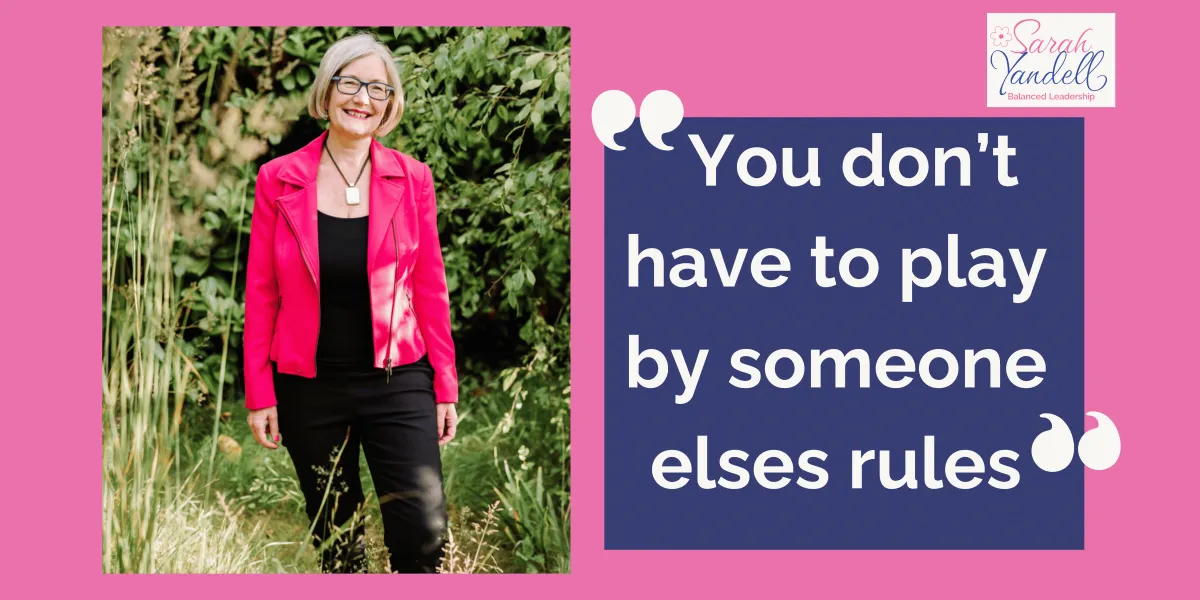
You Don't Have to Play by Someone Else's Rules
In 1965, Harvard Business Review published an article with a title that feels almost impossible to imagine today: "Are Women Executives People?"
It was deliberately provocative, but it reflected the attitudes of the time. Many male executives didn't question whether women were capable of leading. They simply believed senior leadership wasn't where women belonged.
Over the next sixty years, Harvard Business Review revisited the same questions every twenty years to see how attitudes had changed. The good news is they have. Significantly.
The less encouraging news is that many women still experience leadership differently to their male colleagues. In the latest research, 90% of women executives said women are judged more critically than men, yet only 35% of men recognised that difference. Likewise, 83% of women believed they have to be more exceptional than men to succeed, compared with just 28% of men. The gap isn't simply about opportunity anymore. It's about how success is experienced.
Reading the research made me reflect on my own career. Not because I recognised my own experience in those findings, but because I realised how fortunate I've been.
Growing up, I never questioned whether Women could Lead.
My mum ran her own business, so entrepreneurship wasn't unusual in our house. It was simply what she did. I watched her make decisions, solve problems and build something of her own. Without realising it, I grew up believing women could do exactly the same as men.
When I started my career, I worked in the hospitality and travel industry. Looking back, many of the talented leaders around me were women or gay men. It was an environment where ability mattered far more than fitting a particular stereotype. Of course, many of the biggest organisations were still led by men, but at my level I never felt my gender limited what I could achieve.
Later, I had a manager who had enormous faith in me. He gave me opportunities before I felt completely ready and trusted me with responsibility that stretched me. Sometimes all it takes is one person who sees your potential before you do.
Then, before I ever reached the point where many women talk about hitting the glass ceiling, I co-founded my own business. Looking back, I've realised something. I spent my career surrounded by people who judged me on my contribution rather than my gender.
That doesn't mean barriers don't exist. It simply means I was fortunate enough not to experience many of them personally and perhaps that's why I see leadership the way I do today.
The Advantages of being a Founder
When you build your own business, something changes. You're no longer waiting for someone else to promote you. you're no longer trying to fit into someone else's culture and you're no longer hoping your leadership style matches an unwritten set of expectations.
☑️You get to create them.
☑️You decide what great leadership looks like.
☑️You decide whether flexibility is encouraged.
☑️You decide how people are recognised, developed and promoted.
☑️You decide whether the loudest voice gets heard or whether every voice matters.
In many ways, becoming a founder allows you to write your own leadership rules. You don't have to become someone else.
Saying that founders sometimes feel they should instinctively know how to lead. The reality is, very few of us receive any formal leadership training before we're responsible for other people.
👉We become managers because we're good at our jobs.
👉We become founders because we have the courage to build a business.
Neither automatically teaches us how to inspire a team, have difficult conversations, delegate effectively or create a culture where people can thrive.
Great Leaders aren't born. They're Developed
I considered myself very lucky when I was taken on by an international company to set up a business unit from scratch. My boss saw something in me that I hadn't seen in myself - pure determination. I worked my socks off and in return he agreed to invest in my leadership training. I had a fantastic coach and it was a game changer. I went on to build that business unit to a $10 turnover international operation.
Leadership is a skill and like any skill, it can be learned. Perhaps that's another reason I never spent much time worrying about whether I was leading like a man or a woman. I was far more interested in becoming a better leader than trying to fit someone else's definition of one.
Over the years, I've learned from brilliant leaders of every background. Some were women, some were men, some were gay, some were straight. What they had in common wasn't gender or sexuality. It was curiosity. They were always learning, listening and looking for ways to improve.
That's the mindset I encourage every founder to adopt.
Not "How should women lead?"
But "How can I become the best leader my business needs?"
One piece of advice I've heard throughout my career is that women need to become more confident, more assertive or more like traditional leaders. I'm not convinced.
The best leaders I've worked with haven't all looked or behaved the same. Some were decisive and outspoken while others were calm, thoughtful and quietly influential. Some inspired through charisma and others through consistency.
Leadership isn't about fitting a mould. It's about creating clarity, building trust and helping people do their best work. Those qualities aren't masculine or feminine. They're simply good leadership.
Build the Business you Wish you'd Joined
Whether the research resonates with your own experience or not, one thing is certain. As founders, we have an opportunity that previous generations didn't always have. We don't just build businesses, we build cultures.
Every decision we make shapes the experience of the people who work with us. That's a privilege, but it's also a responsibility. So instead of asking whether we fit someone else's idea of leadership, perhaps we should ask a different question.
What kind of leader do I want to be, and what kind of business do I want to build?
One of the advantages of being a founder is that you don't have decades of corporate leadership habits to unlearn. You have the opportunity to learn what good leadership actually is and create your own style from the start. Because when you're the founder, you don't have to wait for a seat at someone else's table.
You have the opportunity to build one of your own.
About the Author
Sarah is a business founder, MBA graduate and coach who has built and scaled businesses to over £8 million in revenue with teams of up to 25.. She now helps ambitious founders gain clarity, build motivated teams and create businesses that support the life they want to lead.
Register to receive her weekly email; The Thoughtful Founder where she'll be sharing honest reflections, lessons learned, and practical strategies from her own journey: co-founding and scaling an £8 million business… while navigating motherhood, financial challenges and self-doubt.
And if you are ready to take the next step, you will find her FREE Webinar will help you
☑️Recruit the right people first time so they fit with your core business values.
☑️Motivate your team and communicate effectively so they consistently deliver beyond expectations
☑️Step back from the day job and replace yourself with your team.
