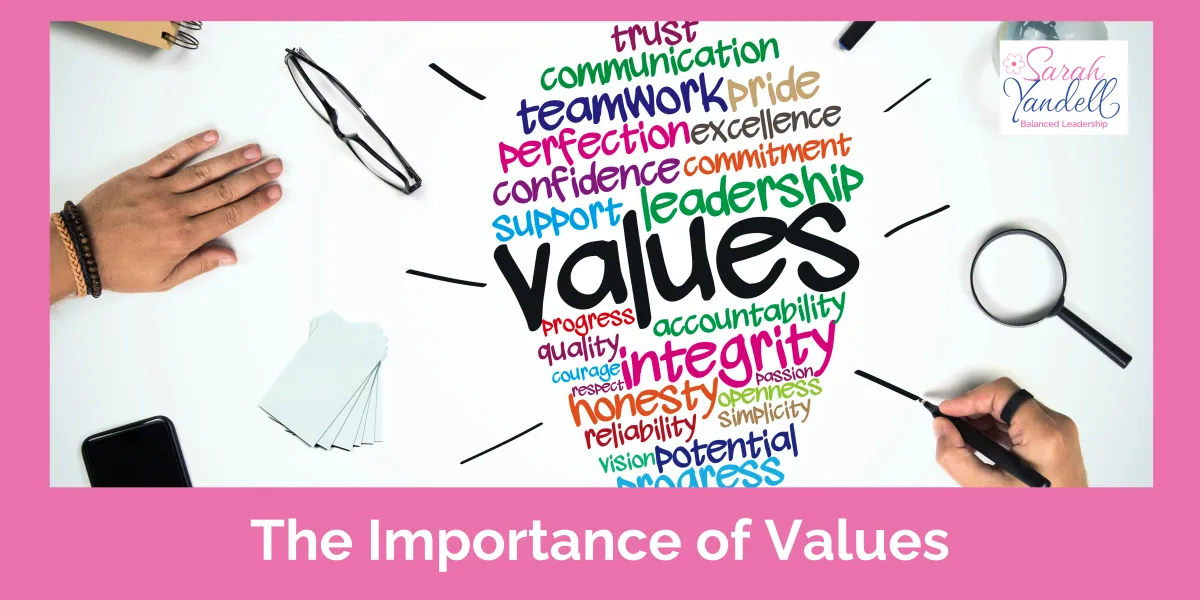
The Importance of Values
Why Balanced Leaders Make Better Decisions
As business owners, we often think decision-making is about speed, confidence, or experience. And while all of those things matter, the most effective leaders I’ve worked with tend to have something else in common: balance. Not balance in the sense of “work-life balance,” although that matters too, but balance in the way they lead, think, and make decisions.
Because when your business is growing, decisions become more complex. You are balancing:
🔷People and performance.
🔷Opportunity and risk
🔷Short-term pressures and long-term vision.
And when things feel uncertain, it becomes very easy to react emotionally, rush decisions, or default to firefighting mode.
That is why everything starts with getting crystal clear on your values. Your values act as a filter for decision-making. They help you make choices with more clarity, consistency, and confidence; especially when there isn’t an obvious right answer.
Why Values Matter More as Your Business Grows
In the early stages of business, many decisions are driven by survival. You say yes to opportunities, work long hours, and solve problems quickly because everything depends on you.
But as your business grows, that approach becomes unsustainable. You cannot build a scalable business by making reactive decisions every day. At some point, you need a framework for how you lead.
I’ve seen this repeatedly when working with growing businesses. The founders who feel constantly overwhelmed are often making decisions based purely on urgency.
The businesses that grow sustainably tend to have stronger alignment between their values, their leadership style, and the way the business operates.
When your values are clear:
☑️Decisions become faster,
☑️Communication becomes clearer,
☑️Teams become more aligned,
☑️And leadership becomes more consistent.
You stop second-guessing every choice because you already know what matters most.
The Importance of a Balanced Approach
One of the biggest mistakes business owners make is leaning too heavily in one direction.
For example:
🔷Focusing only on growth while neglecting systems,
🔷Prioritising profit while ignoring culture,
🔷Or trying to keep everyone happy at the expense of clear leadership.
Sustainable growth requires balance.
That is one of the reasons I built the B.U.I.L.D Framework around multiple interconnected pillars rather than a single business strategy. Growth is rarely held back by one thing alone.
You need:
☑️ A Clear Vision
Balanced leaders make decisions through the lens of where they are trying to go. Without a clear vision and defined values, businesses drift into reactive decision-making. Every opportunity feels urgent. Every problem feels critical.
☑️ Financial Understanding
Balance is essential financially too. Some business owners become overly cautious and avoid investing. Others chase growth without understanding the numbers behind it. Strong decision-making requires both ambition and financial awareness.
☑️ Strong Systems
Good systems create consistency. When your values are embedded into your processes, decision-making becomes easier across the business; not just for you, but for your team.
☑️ The Right People
Balanced leadership also means balancing accountability with support. The best leaders are not simply “nice” or “driven.” They create environments where people feel both challenged and supported.
☑️ And a Long-Term Development Plan.
When one area dominates and the others are neglected, businesses often become unstable. Long-term success comes from making decisions that support the future, not just today’s pressures.
Clarifying Your Own Values
As the founder of your business, your own personal values tend to be interwoven with the values of your business especially in the early stages of growth. In many ways, the business becomes an extension of the founder: their beliefs, standards, behaviours, and ambitions shape the culture from day one.
That can be an enormous strength but it can also create challenges if there is no balance between personal identity and business leadership.
When you start and grow a business, every major decision initially comes through you:
🔷Who you hire,
🔷How customers are treated,
🔷What standards are acceptable,
🔷How problems are handled,
🔷And what growth looks like.
Your personal values naturally influence those decisions.
The Positives of Interwoven Values
Stronger Culture
When business values genuinely reflect the founder’s beliefs, culture tends to feel more authentic. People quickly sense when values are simply marketing language versus genuinely lived behaviours.
Founder-led values often create stronger trust, clearer expectations, better team alignment, and more emotional connection with customers.
Faster Decision-Making
Values act as a shortcut for decision-making. When you know what matters most, decisions become clearer during uncertainty. Strong values reduce hesitation because they provide a framework.
Greater Consistency
Businesses with clear founder-led values often deliver more consistent experiences because decisions are guided by principles rather than moods or short-term pressure. This consistency becomes increasingly valuable as the business grows.
Stronger Brand Identity
Many successful founder-led brands stand out because their values are visible and distinctive. Customers are increasingly drawn to businesses that feel clear in what they stand for. That clarity creates loyalty.
The Challenges of Interwoven Values
However, there is another side to this. When founders become too emotionally connected to the business, it can make growth harder.
Difficulty Delegating
Many founders struggle to let go because the business feels personal. They worry that “Nobody will care as much as I do.” or “Nobody will uphold the standards properly” which often creates bottlenecks.
The founder unintentionally becomes central to every decision because the business is operating through their personal judgement rather than scalable systems and shared leadership.
Emotional Decision-Making
When identity and business become too connected, setbacks can feel deeply personal. A difficult client conversation, team issue, or financial challenge can feel like a reflection of self-worth rather than simply a business problem to solve.
That emotional weight can lead to reactive decisions, overworking, people-pleasing or fear of taking necessary risks. Balanced leadership requires enough separation to make objective decisions while still leading with values.
Resistance to Change
Sometimes founders hold onto ways of working because they reflect personal preferences rather than what the business now needs. But growing businesses evolve. The systems, structure, and leadership style that worked at £100k turnover may not work at £1 million.
Culture Becoming Founder-Dependent
If values only live inside the founder’s head, the business becomes overly reliant on them. This creates risk because teams wait for approval, decisions slow down, accountability weakens and the business struggles to operate independently.
True scale happens when values become embedded into leadership behaviours, systems, communication and decision-making processes.
The Most Effective Balance
The strongest founder-led businesses tend to strike a balance between values-driven leadership and operational objectivity. The founder’s personal values remain visible, but they are translated into scalable business behaviours.
That is where frameworks, systems, and leadership development become critical.
Your personal values are often one of the greatest assets in your business. They shape culture, leadership, trust, and direction. But sustainable growth requires balance.
The goal is not to remove yourself from the business values;— it is to evolve them from being founder-dependent into business-wide principles that guide decisions at every level.
That is when businesses begin moving from personality-led to sustainably led.
About the Author
Sarah is a business founder, MBA graduate and coach who has built and scaled businesses to over £8 million in revenue with teams of up to 25.. She now helps ambitious founders gain clarity, build motivated teams and create businesses that support the life they want to lead.
Register to receive her weekly email; The Resilient Founder where she'll be sharing honest reflections, lessons learned, and practical strategies from her own journey: co-founding and scaling an £8 million business… while navigating motherhood, financial challenges and self-doubt.
And if you are ready to take the next step, you will find her FREE Webinar will help you
☑️Recruit the right people first time so they fit with your core business values.
☑️Motivate your team and communicate effectively so they consistently deliver beyond expectations
☑️Step back from the day job and replace yourself with your team.
