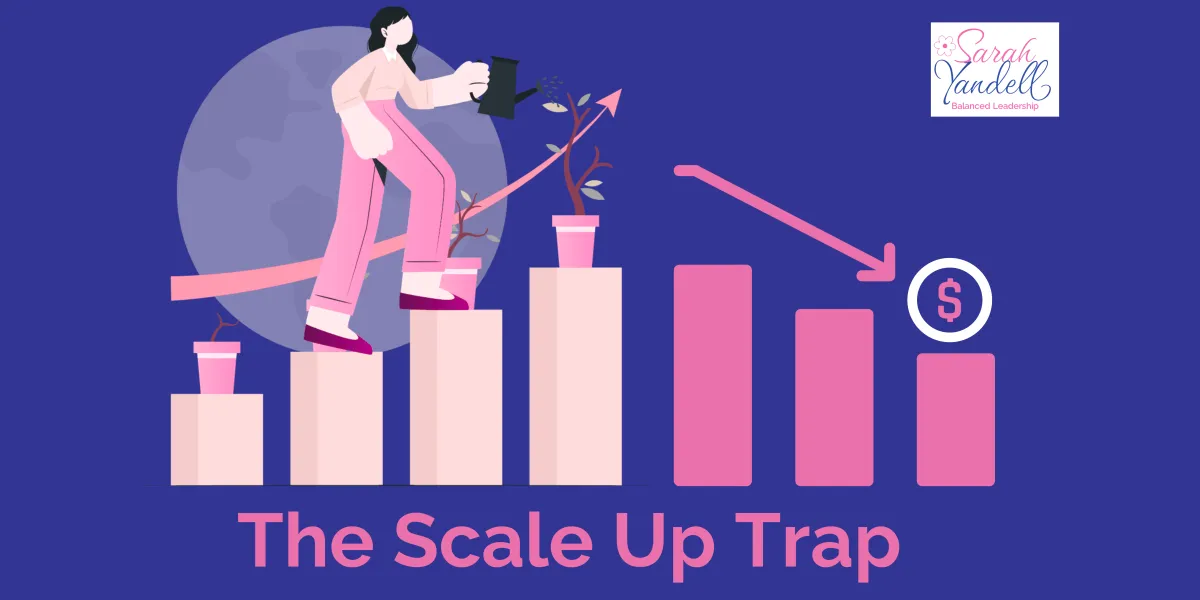
The Scale Up Trap
Why Growth Starts to Feel Harder Instead of Easier
One of the biggest misconceptions in business is that growth automatically creates freedom. In reality, many founders reach a stage where the opposite happens. The business grows, the workload increases, the team expands but somehow the owner becomes even more overwhelmed than before.
I’ve seen this from multiple perspectives as someone who has scaled businesses myself. What I have found in my own and my clients' businesses is that at some point, almost every founder hits what Michael Gerber’s “The E-Myth Revisited” describes as the adolescence stage of business. It’s the stage where the business is no longer a simple start-up, but it also isn’t yet a properly structured company.
And for many founders, it’s the hardest phase of all.
* * E-Myth: The fatal assumption that an individual who understands the technical work of a business can successfully run a business that does that technical work
When Recruiting Makes Things Worse
In the early days, business feels relatively simple.
😀You do the work yourself.
😀You make the decisions
😀You solve the problems.
😀You maintain quality because everything runs through you.
Then growth arrives. At first, it feels exciting - more customers, more revenue and more opportunities. But eventually capacity becomes the problem. You can no longer do everything alone. so you recruit help.
And this is where many founders expect life to get easier.
Instead, it often gets harder.
😒You are fixing mistakes,
😒You are answering constant questions,
😒You are checking work,
😒You are still trying to serve customers yourself.
The founder becomes trapped between operator and manager; carrying both roles badly because there simply isn’t enough time or structure.
This is when the business owner realises: “I can’t do this all by myself anymore.” The problem is that they haven’t yet built the systems, leadership, or operational clarity that allows others to succeed without them.
Recruiting the Wrong People
I experienced this myself when I co-founded a company that grew very quickly. Like many fast-growing businesses, we recruited at speed because demand was increasing and we desperately needed support. We needed people answering the phone and handling new bookings. On paper, the people we hired looked like a good fit - they had travel call centre experience, and were used to handling bookings over the phone.
But we made a critical mistake. The people we hired had been trained to take orders and follow processes rather than proactively develop opportunities. What we actually needed were commercially minded people who could sell and build relationships. So we approached things differently.
We looked for educated people who had worked in front facing roles in hospitality who loved to travel themselves and had most likely taken a gap year after university. These people were keen to learn, to travel and where great at developing relationships with our customers.
Once we had recruited the right people, we then ensured that the induction programme included trips to key cities so they were confident at cross selling and upselling as well as being highly motivated.
This was a powerful lesson. Scaling is not just about recruiting more people. It’s about hiring the right people for the next stage of growth.
The Founder Bottleneck
One of the clearest signs a business is entering the scale-up stage is when the founder becomes the centre of everything. From the outside, the business may look successful, but internally, growth starts slowing because the founder has unknowingly become the bottleneck.
This is where many businesses plateau; not because demand disappears, not because the market changes but because the business structure has not evolved at the same pace as revenue. The irony is that many founders respond by working harder. Longer hours, more involvement, more control.
But scale rarely comes from doing more yourself; it comes from building a business that works consistently without you.
Why Systems Matter More Than Talent
One of the biggest lessons I learned from business scaling is that great businesses are built on systems that help ordinary people perform consistently well.
That does not mean people are unimportant. Far from it. But even talented people struggle in businesses where:
😒Expectations are unclear,
😒Processes only exist in the founder’s head,
😒Decisions constantly change,
😒 Accountability is inconsistent.
When systems are weak, founders compensate with personal effort and eventually that becomes unsustainable. This is why the hardest part is right before the next stage of growth. The old way of operating no longer works, but the new structure has not yet been built.
Scaling Requires a Shift in Identity
What makes this stage particularly difficult is that the founder themselves must change. In the start-up phase, success comes from being the doer. In the scale-up phase, success comes from becoming the leader.
That means shifting from solving every problem to creating systems that solve problems consistently. From personally delivering everything to enabling others to deliver well. And from being indispensable to building something that is sustainable.
And emotionally, that can feel uncomfortable because many founders built their reputation on being highly capable operators. Letting go can feel risky, but sustainable scale always requires moving from technician to leader.
True scale is not about making the business bigger at any cost.
It’s about creating a business that:
☑️operates consistently,
☑️develops capable people,
☑️delivers quality without constant firefighting,
☑️and allows the founder to lead strategically rather than survive operationally.
Within my B.U.I.L.D Framework™ this connects strongly to:
I – Implement robust systems and processes
L – Leverage the strengths of your team.
Because scale only happens when clarity replaces dependency.
Most businesses do not struggle because the founder lacks ambition or work ethic. They struggle because the methods that helped them start the business are not the same methods required to scale it. And that transition can feel messy. especially when recruiting seems to create more problems instead of fewer. But often, that frustration is not a sign the business is failing, it’s a sign the business has outgrown its current structure.
The next stage of growth does not come from working harder inside the business. It comes from building a business that can grow beyond the founder.
About the Author
Sarah is a business founder, MBA graduate and coach who has built and scaled businesses to over £8 million in revenue with teams of up to 25.. She now helps ambitious founders gain clarity, build motivated teams and create businesses that support the life they want to lead.
Register to receive her weekly email; The Resilient Founder where she'll be sharing honest reflections, lessons learned, and practical strategies from her own journey: co-founding and scaling an £8 million business… while navigating motherhood, financial challenges and self-doubt.
And if you are ready to take the next step, you will find her FREE Webinar will help you
☑️Recruit the right people first time so they fit with your core business values.
☑️Motivate your team and communicate effectively so they consistently deliver beyond expectations
☑️Step back from the day job and replace yourself with your team.
